
Solar Panel Articles
by R&B Mechanical & Electrical
Essential Roof Access for Commercial Solar Panel Maintenance in the UK
Investing in commercial solar panels for your industrial unit is a smart, forward-thinking business decision. You’re securing lower energy bills, bolstering your green credentials, and future-proofing your operations. But here’s the often-overlooked secret to a successful installation: safe, continued access for maintenance.
Without proper, planned access, your long-term return on investment (ROI) is jeopardised, and, most importantly, lives are put at risk. This guide is designed to inform on the best practices for guaranteeing safe and compliant maintenance access.
- Why Continued Roof Access is Required for Commercial Solar Maintenance
While solar panels are robust, they are not a ‘fit and forget’ solution. Regular maintenance is essential for peak efficiency and long-term asset protection.
Establishing the Need
Maintenance is required to:
- Prevent Performance Degradation: Routine inspection and cleaning (especially in high-dust or high-bird-traffic areas) prevents reduced energy yield caused by soiling.
- Ensure System Health: Engineers must inspect electrical components (inverters, wiring, isolators) and structural mounting systems for wear, damage, or degradation.
- Comply with Warranties: Most manufacturer warranties require scheduled inspections and maintenance to remain valid.
- Meet Building/Lease Obligations: Your building insurance or commercial lease may mandate safe access systems for all rooftop plant, including solar.
This requirement must be established before installation, typically at the design and planning stage, and should be part of a formal Operations and Maintenance (O&M) plan.
Design Stage Documentation: Demonstrating Compliance
The requirement for safe access is a critical part of the design phase, particularly under the UK’s Construction (Design and Management) Regulations 2015 (CDM 2015).
| Document | Purpose |
| Design & Access Statement | A key planning document that details how safety and access have been factored into the design. |
| Risk Assessment & Method Statement (RAMS) | Details the hazards associated with working on the specific roof and near the system, and the controls put in place for maintenance work. |
| O&M Manual | A detailed guide handed over to the client, which must clearly outline the safe route of access and the safety systems to be used for future maintenance. |
Failure to factor in safe access at the design stage can lead to costly retrospective modifications or non-compliance with health and safety laws.
- The Inherent Risks: Working at Height on Solar Arrays
Any work carried out on a commercial industrial roof in the UK is classed as Working at Height, which is governed by the Work at Height Regulations 2005. Falls remain one of the biggest causes of workplace fatalities and major injuries.
The Specific Risks to Solar Maintenance Engineers:
- Falls from an Edge: The obvious risk—falling off the perimeter of the roof.
- Fragile Surfaces: Falling through a fragile roof surface, such as skylights or old roof sheeting.
- Trip Hazards: Cables, module edges, and mounting frames create significant trip hazards across the work area.
- Electrical Hazards: Solar panels are always live when exposed to light, posing an electrical risk that requires highly trained personnel and specific Personal Protective Equipment (PPE).
- Permanent Access Structures: The Gold Standard Solution
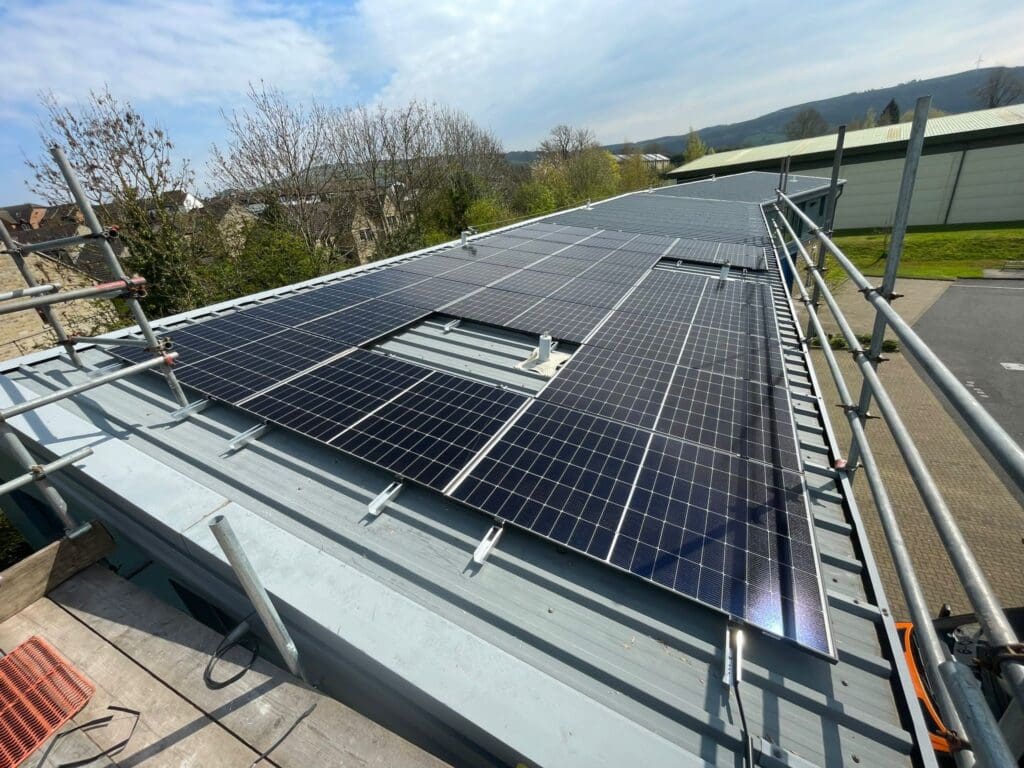
While temporary measures like scaffolding or Mobile Elevated Work Platforms (MEWPs) can be used, a permanent access structure is overwhelmingly the best solution for ongoing commercial solar maintenance.
Why Permanent is Best:
- Hierarchy of Control: UK Health & Safety Executive (HSE) guidance dictates that collective fall prevention (e.g., a permanent guardrail) is preferable to personal fall protection (e.g., a harness and wire system)
- Immediate Safety: Maintenance can be performed safely, at any time, without the delay, cost, and logistics of hiring and erecting temporary safety systems.
- Low Skill Requirement: Personnel only need basic roof access training, not the advanced skills required for complex personal rope/harness systems.
Available Permanent Access Systems in the UK
The right system depends on the specific roof type (flat or pitched), the roof material, and the array layout.
- Collective Fall Protection (The Best Option)
- Guardrail Systems: Freestanding, non-penetrative guardrail systems placed around the roof perimeter provide a collective barrier that protects everyone on the roof, without damaging the roof membrane. This is the simplest and most effective solution.
- Walkways/Staging: Permanent, non-slip walkway systems installed across the roof, providing a safe, defined route through the array to access key components (like inverters) and ensuring maintenance engineers do not step on fragile surfaces or the solar panels themselves.
- Personal Fall Protection (An Alternative)
- Horizontal Lifeline Systems (Man-Safe): A permanent wire/track system securely fixed to the roof structure. Maintenance staff clip into this system using a harness and lanyard, which arrests a fall if they slip. Crucially, these systems require the user to have specific training, certified PPE, and a documented rescue plan. They also need annual inspection and re-certification.
Access Points
- Fixed Roof Hatches/Stairs: For flat roofs, installing a permanent, secure, lockable roof hatch with a fixed ladder or scissor stair provides the safest and most convenient access point from inside the building.
The Bottom Line
For your commercial solar investment to deliver decades of reliable, safe, and efficient power, the planning of continued, safe roof access is as important as the panel specification itself.
A permanent, collective fall protection system (like a non-penetrative guardrail) is the safest, most cost-effective, long-term solution for maintaining compliance and protecting the people who look after your investment.
️ The Gold Standard: Non-Penetrative Guardrail Systems Explained
When it comes to providing safe, ongoing maintenance access on a commercial flat roof, the non-penetrative guardrail system stands out as the ultimate solution for several compelling reasons: compliance, long-term cost-effectiveness, and, crucially, roof integrity.
- What is a Non-Penetrative Guardrail?
A non-penetrative, or ‘free-standing’, guardrail is a collective fall protection system that provides a robust safety barrier around the perimeter of a flat or low-slope roof without needing to drill or bolt into the roof membrane.
- How it Works: The system is secured using weighted, rubber-based counterweights placed on the roof surface. These weights hold the rail upright against any potential force, ensuring stability without compromising the roof’s waterproofing layer.
- The Compliance Advantage: Under the UK’s Work at Height Regulations, a permanent guardrail is a form of collective protection. This is the second-highest measure on the Hierarchy of Control (after eliminating the risk entirely), making it superior to personal systems like anchor points and harnesses.
- Key Benefits for Commercial Clients
| Feature | Client Benefit | Straight Talk |
| No Roof Penetration | Eliminates the risk of leaks, maintaining the roof warranty and structural integrity. | No leaks, no drama. Your roof stays watertight, guaranteed. |
| Collective Protection | Protects any worker who accesses the roof—not just those trained in harness use. | Anyone competent can safely access the edge without complex PPE or a detailed rescue plan. |
| Instant Access | No need to hire, erect, or dismantle scaffolding for every maintenance check. | Saves significant time and money on every single service visit over the 25+ year lifespan of the solar system. |
| Defined Safe Zone | Clearly delineates the safe working area, keeping maintenance teams well away from the hazardous roof edge and potentially fragile areas. | Clear boundaries mean less worry about accidental falls or workers straying into risky zones. |
- Design and Installation Specifics
Integrating a non-penetrative guardrail alongside a large PV array requires meticulous planning:
- Spacing and Set-Back
- The guardrail should be installed a specific distance from the roof edge, determined by the manufacturer’s design calculations and load testing. This distance, along with the weight of the counterweights, is what provides stability.
- Crucial Planning: You must ensure the guardrail is positioned so it does not shade the solar panels at any point of the year, as even partial shading can significantly reduce the output of a string of panels. Our design team can manage this specific challenge at the initial layout stage.
- Integration with the PV Array
- The guardrail system should create a continuous, safe perimeter around the entire solar array and the roof edge.
- Safe Route: If the solar array covers most of the roof, the design must also include designated, safe walkways (often integrated with the guardrail supports) to allow Engineers to move from the access point (e.g., roof hatch) to critical components like inverters or isolation switches. These walkways prevent Engineers from having to walk on fragile roof material or the panels themselves.
- Compliance and Certification
To ensure the system is fit for purpose and compliant with UK law, your installer must ensure the guardrail system meets:
- BS EN 14122-3: Permanent means of access to machinery.
- BS EN 13374: Temporary edge protection systems (used as a benchmark for loading).
The system should be supplied with full documentation and a declaration of conformity, which forms part of your legal and safety paperwork upon project handover.
A non-penetrative guardrail is not just a safety feature; it’s a fundamental piece of infrastructure that guarantees the longevity, compliance, and maintainability of your commercial solar investment. It ensures that your commitment to green energy doesn’t come at the cost of your employees’ or contractors’ safety.

Our Services
Commercial Solar Panels
We have designed and installed high yield commercial solar panel systems for many clients. We can provide all design and payback calculations and ongoing maintenance.
Agricultural Solar Panels
We have many years experience designing and installing agricultural solar panel systems for farm businesses and saving them huge costs on electrical energy.
Residential Solar Panels
Our design and solar panel installation engineers have over a decade of experience installing and maintaining solar PV systems for residential customers across the UK
Electrical Contractors
We are NICEIC registered electrical contractors and members of the Electrical Contractors Association for all industrial, commercial and residential electrical services including testing, inspection and compliance services.
Mechanical Services
We offer M&E design, calculation, estimation and full fit-out, installation and maintenance services to commercial clients. We also provide contract maintenance and building compliance and testing services
Solar Renewables
We are MCS and RECC registered solar panel installers for all commercial and residential solar panel installations including ground arrays and roof mounted PV systems and battery storage configurations.
EV Home Chargers
We fit all makes, models and types of EV Chargers for residential customers. We are Office for Zero Emission Vehicles (OZEV) authorised installers.
EV Workplace Chargers
We can undertake all required aspects of commercial EV charging point installation, from initial design and consultation to servicing and on-going maintenance.
Gas Boiler Engineers
We are Gas Safe Registered and undertake boiler installation, servicing and all gas safety checks for landlords and residential customers.
Solar Panel Installer
Photovoltaic Systems generate no greenhouse gases, a typical domestic system can save approximately 1.2 tonnes of carbon dioxide emissions per year – adding up to almost 30 tonnes over a system’s lifetime.
Our design and solar panel installation engineers have many years experience installing solar PV systems for industrial and commercial clients.
Contact Us
Solar Panel Enquiry
Address
Keighley, West Yorkshire
BD21 4PF
UK
What3Words
What3Words:///clocks.decide.pokers
Phone
Keighley: 01535 687010 Skipton: 01756 793039