

Solar Panel Battery Storage
by R&B Mechanical & Electrical
Solar Panel Battery Storage

Solar Battery Storage in the UK: Is it Worth the Investment?
The UK’s commitment to renewable energy is stronger than ever, and solar panels are a familiar sight on many rooftops. However, to truly maximise the benefits of solar energy, battery storage is becoming an increasingly popular and essential addition. This article will explore the advantages of integrating battery storage with solar panel systems in the UK, particularly for retrofit operations, and delve into whether it’s a worthwhile investment for both residential and commercial properties.
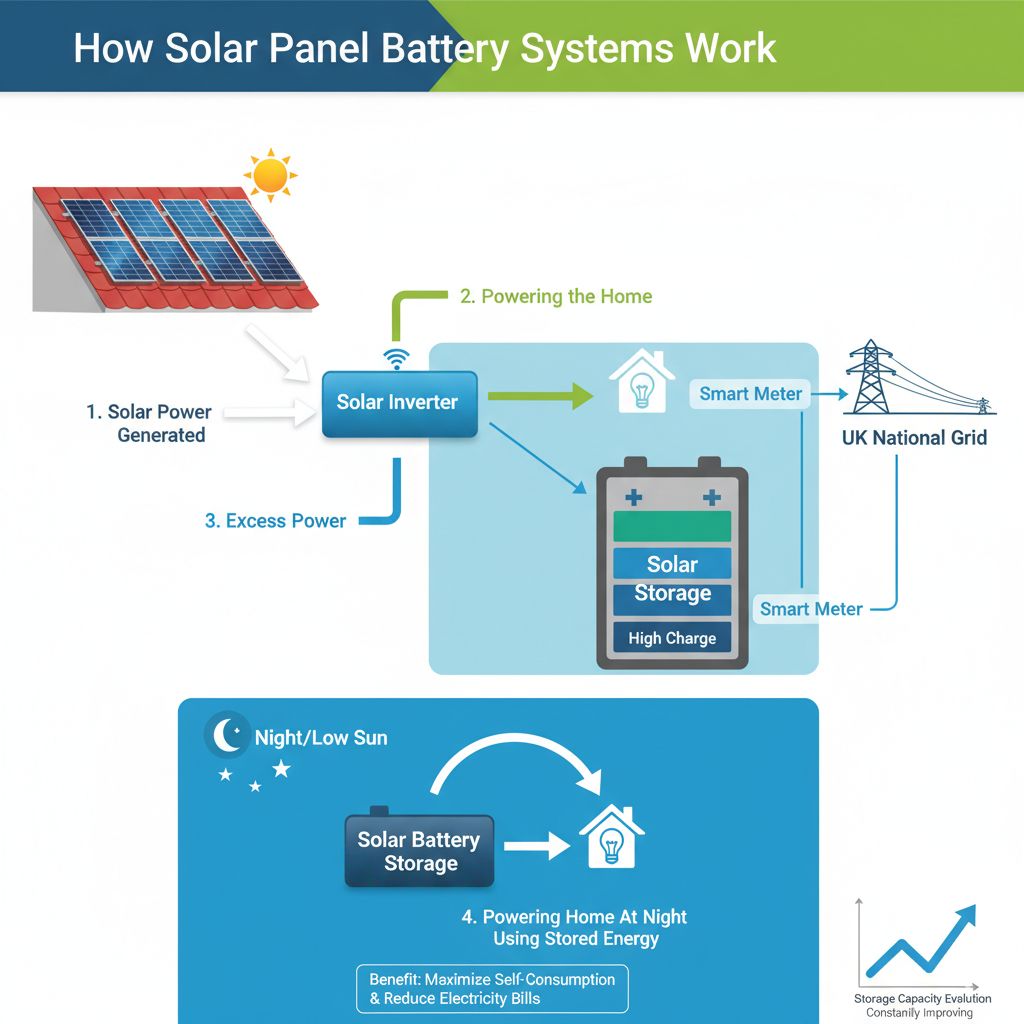
How Solar Panel Battery Systems Work
At its core, a solar panel battery system captures and stores the excess electricity generated by your solar panels that isn’t immediately used by your property. During daylight hours, when solar panels are most productive, they often generate more electricity than a home or business consumes. Without battery storage, this surplus energy is typically exported back to the grid for a small payment (through schemes like the Smart Export Guarantee).
With a battery, however, this excess energy is diverted to charge the battery. When the sun isn’t shining – at night, on cloudy days, or during periods of high electricity demand – your property can then draw power directly from the stored energy in the battery rather than importing electricity from the grid. This significantly increases self-consumption of your generated solar power.
The technology behind these batteries is constantly evolving. Modern solar batteries, primarily lithium-ion, are becoming more efficient, compact, and are boasting ever-increasing storage capacities. This continuous improvement means that even older solar panel installations can benefit from the latest battery technology as a retrofit.
Residential Solar Battery Storage: Benefits and Investment
For homeowners in the UK, adding battery storage to an existing or new solar panel system offers a compelling array of benefits:
- Maximised Self-Consumption: This is perhaps the biggest advantage. Instead of selling your excess solar energy back to the grid for a low rate and then buying electricity back at a higher rate later, you store and use your own free, clean energy. This significantly reduces your reliance on grid electricity and can lead to substantial savings on your energy bills.
- Reduced Electricity Bills: By using more of your self-generated power, you minimise the amount of electricity you need to purchase from your energy supplier, directly lowering your monthly bills.
- Energy Independence and Security: Batteries provide a degree of energy independence, especially during power outages. While most grid-tied battery systems won’t automatically provide backup power unless specifically designed with a ‘black start’ or ‘EPS’ (Emergency Power Supply) function, they reduce your vulnerability to fluctuating energy prices and supply issues.
- Optimised Energy Tariffs: Some energy tariffs offer cheaper electricity during off-peak hours. With a smart battery system, you can charge your battery from the grid during these cheaper periods and use that stored energy during peak, more expensive times, further optimising your savings.
- Environmental Impact: By increasing your self-consumption of renewable energy, you further reduce your carbon footprint, contributing to a greener future.
How Many Batteries for a Residential System?
The number of batteries required for a residential system depends on several factors: your daily energy consumption, the size of your solar array, and your desired level of energy independence.
- A typical UK home might use between 8-10 kWh of electricity per day.
- Most residential solar batteries offer capacities ranging from 3 kWh to 15 kWh.
- A common approach is to size the battery to cover your evening and night-time electricity usage. For a standard 3-4 kWp solar panel system on a UK roof, a single 5 kWh to 10 kWh battery unit is often sufficient to store a significant portion of the day’s excess generation. Some households with higher energy demands or larger solar arrays might opt for two such units.
Average Installation Costs and Payback Timescales (Residential):
- Costs: As of 2023/2024, the average cost for a retrofit solar battery installation in the UK (including the battery unit, inverter upgrades if necessary, and labour) can range from £4,000 to £8,000 for a typical 5-10 kWh system. Prices vary based on battery brand, capacity, and complexity of installation.
- Payback Timescales: Payback periods for residential battery storage are influenced by several factors, including the initial cost, your electricity usage patterns, the unit price of electricity, and the export tariff you receive. Generally, payback periods can range from 6 to 12 years. As electricity prices continue to rise and battery technology becomes more affordable, these payback times are likely to shorten.
- Return on Investment (ROI): While direct ROI calculation can be complex due to varying electricity prices and usage, a battery can significantly increase the overall financial viability of your solar system by boosting your self-sufficiency. Over the lifespan of a battery (typically 10-15 years), the savings generated can easily exceed the initial investment.
Commercial Solar Battery Storage: Benefits and Investment
For businesses, integrating battery storage with commercial solar installations presents even more significant opportunities for cost savings and operational efficiency:
- Peak Shaving: Commercial properties often incur high electricity charges during peak demand hours. Batteries can discharge stored energy during these peak periods, reducing the amount of electricity drawn from the grid and thus significantly lowering peak demand charges, which can be a substantial portion of a business’s electricity bill.
- Demand-Side Response (DSR): Businesses with battery storage can participate in DSR schemes, where they are paid by the National Grid to either reduce their electricity consumption or feed stored energy back into the grid during times of high national demand. This provides an additional revenue stream.
- Arbitrage: Similar to residential smart tariffs, businesses can charge their batteries during off-peak hours when electricity is cheaper and then use or sell that stored energy during more expensive peak times.
- Enhanced Energy Resilience: For critical operations, battery storage can provide vital backup power during grid outages, ensuring business continuity.
- Reduced Carbon Footprint and Green Credentials: Demonstrating a commitment to sustainability can enhance a company’s brand image and attract environmentally conscious customers and investors.
How Many Batteries for a Commercial System?
Commercial battery sizing is highly bespoke, depending on the scale of the solar array, the business’s energy profile, peak demand, and specific operational goals (e.g., peak shaving, DSR participation).
- Commercial battery systems are often modular, ranging from tens of kWh to MWh.
- For a commercial building with a 50 kWp to 250 kWp solar array, multiple battery units are typically deployed. The total capacity could range from 50 kWh to 500 kWh or more, strategically located to optimise energy flow.
- The number of individual batteries will vary, but it’s common to see banks of commercial-grade battery units working in concert.
Average Installation Costs and Payback Timescales (Commercial):
- Costs: Commercial battery storage costs are highly variable due to scale. A system ranging from 50 kWh to 250 kWh could cost anywhere from £30,000 to £200,000+, depending on the technology, integration complexity, and desired features.
- Payback Timescales: Commercial payback periods are often shorter than residential ones due to the larger scale of savings and potential for revenue generation from DSR. Payback can typically range from 4 to 8 years, particularly for businesses with significant peak demand charges.
- Return on Investment (ROI): Commercial ROI can be substantial, driven by significant electricity bill reductions, peak demand charge avoidance, and potential new revenue streams. The strategic deployment of battery storage can offer a strong business case.
What Happens to Excess Electricity Once Batteries Are Full?
Once your solar batteries are fully charged, any further excess electricity generated by your solar panels will be exported back to the national grid. In the UK, you can benefit from the Smart Export Guarantee (SEG). Under SEG, licensed electricity suppliers must offer a tariff for electricity exported to the grid from eligible renewable installations. The rates vary between suppliers, so it’s worth shopping around to find the best deal.
Future Outlook for Battery Storage Costs
The trend for battery storage costs is downwards. As demand increases globally and manufacturing processes become more efficient, the cost of batteries is expected to continue to decrease. This, coupled with advancements in technology that boost efficiency and lifespan, will make battery storage an even more attractive investment in the coming years. Increased take-up will also drive competition among manufacturers and installers, further contributing to cost reductions.
Conclusion
Integrating battery storage into your solar panel system, whether a new installation or a retrofit, offers substantial benefits for both residential and commercial properties in the UK. From significant savings on electricity bills and enhanced energy independence to new revenue streams and reduced carbon footprints, the investment case is strong. While initial costs exist, falling prices and continuous technological improvements are making solar battery storage an increasingly accessible and worthwhile solution for anyone looking to truly harness the power of the sun. The move towards a smarter, more resilient, and sustainable energy future undoubtedly has battery storage at its heart.
Next….Contact Us
Commercial Solar Panels
We have designed and installed high yield commercial solar panel systems for many clients. We can provide all design and payback calculations and ongoing maintenance.
Agricultural Solar Panels
We have many years experience designing and installing agricultural solar panel systems for farm businesses and saving them huge costs on electrical energy.
Residential Solar Panels
Our design and solar panel installation engineers have over a decade of experience installing and maintaining solar PV systems for residential customers across the UK
Electrical Contractors
We are NICEIC registered electrical contractors and members of the Electrical Contractors Association for all industrial, commercial and residential electrical services including testing, inspection and compliance services.
Mechanical Services
We offer M&E design, calculation, estimation and full fit-out, installation and maintenance services to commercial clients. We also provide contract maintenance and building compliance and testing services
Solar Renewables
We are MCS and RECC registered solar panel installers for all commercial and residential solar panel installations including ground arrays and roof mounted PV systems and battery storage configurations.
EV Home Chargers
We fit all makes, models and types of EV Chargers for residential customers. We are Office for Zero Emission Vehicles (OZEV) authorised installers.
EV Workplace Chargers
We can undertake all required aspects of commercial EV charging point installation, from initial design and consultation to servicing and on-going maintenance.
Gas Boiler Engineers
We are Gas Safe Registered and undertake boiler installation, servicing and all gas safety checks for landlords and residential customers.
Contact Us
Solar Battery Enquiry
Address
Unit 5, Devonshire Works, Pitt Street
Keighley, West Yorkshire
BD21 4PF
What3Words
What3Words:///clocks.decide.pokers
Phone
Keighley: 01535 687010 Skipton: 01756 793039