

Solar Panel Articles
by R&B Mechanical & Electrical
Will the cost of installing commercial solar panels in the UK come down in 2026?
When considering a significant capital investment like solar energy, UK businesses face a complex landscape. The central question for 2026 is no longer just about the “sticker price” of the panels, but rather the total installed cost versus the accelerating efficiency of the technology.
This article provides an authoritative breakdown of the commercial solar market for 2026, exploring whether costs are truly falling and how emerging technologies are shifting the ROI equation.
Establishing Average Installation Costs in 2026
To determine whether a system is fairly priced, businesses typically use three primary metrics. In 2026, the industry standard for “fair value” is increasingly calculated per kWp (Kilowatt Peak), though physical dimensions remain vital for planning.
- Cost per kWp (Capacity)
This is the most reliable “benchmark” for commercial systems. By 2026, typical costs are expected to settle within these ranges:
- Small Commercial (10–30kWp): £1,100 – £1,400 per kWp.
- Medium Commercial (50–100kWp): £850 – £1,050 per kWp.
- Large Scale (250kWp+): £700 – £850 per kWp.
- Roof-Mounted vs. Ground-Mounted Systems
The installation method significantly impacts the final bill.
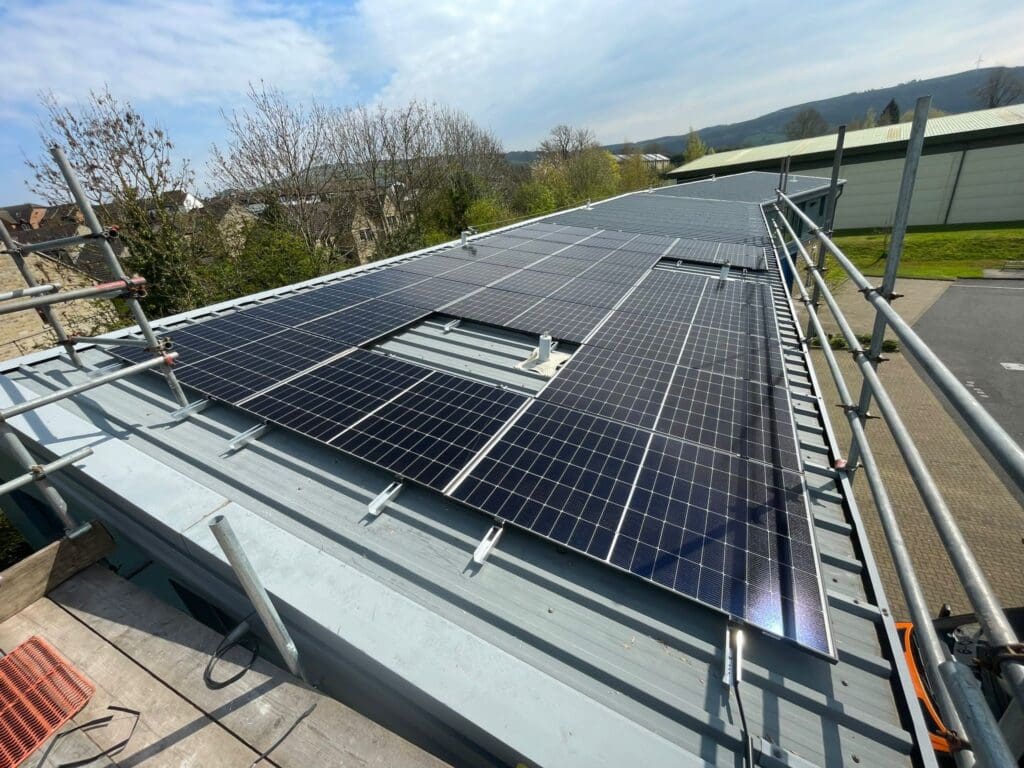
- Roof-Mounted: Generally the most cost-effective. Prices are driven by roof type (pitched vs. flat) and the need for specialized mounting rails. Flat roofs often require “ballasted” systems to avoid piercing the membrane, which can slightly increase labor and material costs.
- Ground-Mounted: Typically 15% to 20% more expensive than roof systems. This premium accounts for groundwork, trenching for cables, and robust steel or aluminum frameworks. However, ground-mounted systems often yield 10% more energy as they can be oriented at the perfect angle (usually 35°) regardless of the building’s position.
- Square Meterage and Yield
On average, 1kWp of solar requires approximately 6–7 square metres of roof space. A 50kWp system—common for medium warehouses—would require roughly 300–350m².
Inflation vs. Innovation: Will Prices Ever Truly Drop?
While the raw cost of solar modules (the panels themselves) has plummeted by over 80% in the last decade, the installed cost is currently battling two opposing forces: Material/Labour Inflation and Technological Gains.
The Inflation Headwind
By 2026, persistent inflation in the UK construction sector is expected to keep labour and non-panel material costs (copper cabling, steel mounting, and electrical switchgear) elevated.
- Labour: A shortage of MCS-certified commercial electricians has pushed day rates up.
- Balance of System (BoS): While panels are cheaper, the “everything else”—inverters, cabling, and scaffolding—now accounts for nearly 60-70% of the total project cost.
The Technology Tailwinds
The “effective” price is coming down because you now get more power for the same footprint.
- TOPCon and Tandem Cells: In 2026, TOPCon (Tunnel Oxide Passivated Contact) cells have become the industry standard, offering efficiencies of 23–25%, compared to the 18–20% common a few years ago.
- Bifacial Panels: Most commercial installs now use bifacial panels that capture light on both sides. On light-colored flat roofs or ground mounts, this can increase energy yield by up to 10–15% for a negligible increase in panel cost.
Authoritative Insight: Because of these efficiency gains, the Cost per kWh produced is falling, even if the Cost per Installation remains steady due to inflation.
The 2026 Gamechanger: Battery Storage Evolution
For many UK businesses, the real shift in 2026 isn’t the panels—it’s the storage.
Sodium-Ion Batteries
2026 marks the commercial “take-off” point for Sodium-Ion technology in the UK. Unlike Lithium-Ion, sodium is abundant and cheaper to refine. While slightly heavier, this is irrelevant for stationary commercial buildings. Sodium-ion batteries offer:
- Lower fire risk: Crucial for insurance premiums in commercial settings.
- Better performance in cold climates: Ideal for UK winters.
- Cost Reductions: Expected to be 20–30% cheaper than Lithium-Ion once scaled.
Long-Duration Storage (LDES)
The UK government’s “Cap and Floor” scheme for long-duration storage is reaching maturity in 2026. This allows businesses to invest in systems that can discharge energy for 8+ hours, moving beyond just “smoothing out” clouds to fully powering night shifts with yesterday’s sunshine.
Summary: Should You Wait?
Will costs come down in 2026? In real terms, yes. While the total invoice amount might not drop significantly due to labor and material inflation, the return on investment (ROI) is strengthening.
With efficiency gains and the maturation of cheaper battery tech, a system installed in 2026 will produce more electricity over its 25-year lifespan than a similarly priced system from 2023. Furthermore, with the Annual Investment Allowance (AIA) still allowing businesses to deduct 100% of the cost from taxable profits, the “day one” financial incentive remains powerful.

Our Services
Commercial Solar Panels
We have designed and installed high yield commercial solar panel systems for many clients. We can provide all design and payback calculations and ongoing maintenance.
Agricultural Solar Panels
We have many years experience designing and installing agricultural solar panel systems for farm businesses and saving them huge costs on electrical energy.
Residential Solar Panels
Our design and solar panel installation engineers have over a decade of experience installing and maintaining solar PV systems for residential customers across the UK
Electrical Contractors
We are NICEIC registered electrical contractors and members of the Electrical Contractors Association for all industrial, commercial and residential electrical services including testing, inspection and compliance services.
Mechanical Services
We offer M&E design, calculation, estimation and full fit-out, installation and maintenance services to commercial clients. We also provide contract maintenance and building compliance and testing services
Solar Renewables
We are MCS and RECC registered solar panel installers for all commercial and residential solar panel installations including ground arrays and roof mounted PV systems and battery storage configurations.
EV Home Chargers
We fit all makes, models and types of EV Chargers for residential customers. We are Office for Zero Emission Vehicles (OZEV) authorised installers.
EV Workplace Chargers
We can undertake all required aspects of commercial EV charging point installation, from initial design and consultation to servicing and on-going maintenance.
Gas Boiler Engineers
We are Gas Safe Registered and undertake boiler installation, servicing and all gas safety checks for landlords and residential customers.
Solar Panel Installer
Photovoltaic Systems generate no greenhouse gases, a typical domestic system can save approximately 1.2 tonnes of carbon dioxide emissions per year – adding up to almost 30 tonnes over a system’s lifetime.
Our design and solar panel installation engineers have many years experience installing solar PV systems for industrial and commercial clients.
Contact Us
Solar Panel Enquiry
Address
Keighley, West Yorkshire
BD21 4PF
UK
What3Words
What3Words:///clocks.decide.pokers
Phone
Keighley: 01535 687010 Skipton: 01756 793039