
Solar Panel Articles
by R&B Mechanical & Electrical
Are Solar Facades Viable in the UK?
An Authoritative Commercial Guide
As UK commercial enterprises strive toward Net Zero targets, traditional rooftop solar PV remains a primary solution. However, as urban areas density increases, and roof space becomes a premium, architects, developers, and asset managers are looking elsewhere: the building envelope.
But are solar facades—either retrofitted to existing structures or integrated into new designs—genuinely viable in the UK’s famously overcast climate?
The short answer is yes. When planned correctly, solar facades are not only viable but offer distinct, complementary advantages that traditional rooftop installations cannot match. Below, we break down the engineering, design considerations, regulatory environments, and financial benefits of commercial solar facades in the UK.
- How Solar Facades Work vs. Roof-Mounted Panels
Solar facades fall into two primary categories:
- Building-Integrated Photovoltaics (BIPV): Solar cells are manufactured directly into the building materials, replacing traditional components like curtain walling, rainscreen cladding, or glazing.
- Building-Applied Photovoltaics (BAPV): Standard solar panels mounted on top of an existing vertical wall structure using specialized racking.
The Physics of Vertical Solar in the UK
The primary objection to solar facades is the vertical angle. In the UK, the optimal tilt for annual solar yield is between and south-facing, allowing panels to capture peak summer sunlight. A vertical facade ( angle) generates roughly 30% to 35% less total annual energy than an optimally tilted roof-mounted system of the same size.
However, looking strictly at “annual totals” misses a massive operational benefit: seasonal yield optimization.
During a UK winter, the sun sits low on the horizon (often lower than in December).
- Pitched Roofs (): Receive angled, weaker light.
- Vertical Facades (): Act as direct targets for the low-angled winter sun, capturing direct horizontal radiation.
- Albedo Effect: Vertical panels capture reflected light from the ground, nearby roofs, and snow far more effectively than flat or slightly pitched roofs.
| Performance Metric | Roof-Mounted Solar (35∘ Tilt) | Vertical Solar Facade (90∘ Tilt) |
| Peak Generation Season | Summer (June–August) | Autumn / Winter (October–February) |
| Soiling & Snow Accumulation | Susceptible; requires regular cleaning | Negligible; self-cleaning via heavy rainfall |
| Diffuse Light Capture | High | Moderate-High (excellent with bifacial tech) |
| Daily Generation Profile | Sharp midday peak | Broader, flatter generation curve |
- Design Considerations: Maximize Your Vertical Assets
When designing a solar facade, three primary variables determine viability:
Orientation and Shading
South-facing facades remain the gold standard, but East and West-facing facades are exceptionally useful for commercial offices. They capture early morning and late afternoon sun, directly matching the standard 9-to-5 energy usage curve of a commercial facility, reducing the reliance on costly grid electricity during peak pricing hours. North-facing facades are highly inefficient and are not recommended.
Active Shading (Brise Soleil)
Instead of flat cladding, BIPV can be integrated into projecting louvres or brise soleil systems. These structures provide dual benefits:
- They are angled optimally (e.g., ) to capture maximum solar energy.
- They physically shade the building interior, dramatically reducing summer solar heat gain and lowering commercial HVAC cooling costs.
Co-Generation: The “Hybrid Envelope” Approach
For the highest self-consumption rates, a hybrid system combining rooftop solar with a solar facade is ideal.
Expert Insight: Rooftop solar provides massive bulk generation during spring and summer. The solar facade acts as a winter buffer, lifting the generation floor when the roof panels are underperforming. This dual-source approach flattens your generation curve, making on-site battery storage much more efficient to size and manage.
- Suitable Facade Types and Structural Limitations
Solar facades are highly versatile but require the right structural canvas.
- Rainscreen Cladding Systems: This is the most common retrofitting method. Lightweight BAPV panels or BIPV composite panels are mounted onto a metal sub-frame anchored to the structural masonry or concrete core of the building.
- Curtain Walling & Glazing: Ideal for new office builds or major refurbishments. Semi-transparent BIPV glass can replace standard window glass in non-vision areas (spandrel panels) or even act as tinted double-glazing, generating power while letting in natural daylight.
- Masonry and Concrete: Solid load-bearing walls are highly suitable but require engineering checks to ensure the anchors can withstand wind-loading forces, which are significantly higher on vertical surfaces than on flat roofs.
Structural Limitations
Historically, lightweight timber frame buildings are less suitable for heavy vertical glazing systems due to structural load limits. Additionally, highly irregular facades with deep recesses, architectural column projections, or heavy shading from neighboring high-rises will severely limit viability.
- UK Planning and Permitted Development (PD) Rights
Navigating local planning authorities is a key step in any commercial solar project.
- Permitted Development: Under Part 14 of the General Permitted Development Order (GPDO), many non-domestic rooftop solar projects proceed without a full planning application.
- The Facade Catch: While PD rights do technically cover wall-mounted solar on commercial buildings, there are strict caveats. You will require full planning permission if:
- The installation is in a Conservation Area or Area of Outstanding Natural Beauty (AONB) and the wall faces a public highway.
- The building is a Listed Building or Scheduled Monument (which requires specialized Listed Building Consent).
- The panels project more than 200mm from the wall surface.
- Prior Approval: Local Planning Authorities (LPAs) may require a Prior Approval process to assess design, glare, and visual impact on neighboring properties.
- Safety Regulations: Fire Performance & Public Protection
Commercial developers must address two critical safety concerns: fire propagation and ground-level durability.
Fire Safety and Building Regulations (Approved Document B)
In the post-Grenfell regulatory landscape, fire safety is paramount. The UK has strict bans on combustible materials on the external walls of high-rise buildings.
- Relevant Height Thresholds: For commercial buildings above 18 metres (and residential/educational buildings over 11 metres), all materials forming part of the external wall must achieve a Euroclass rating of A1 (non-combustible) or A2-s1, d0 (limited combustibility).
- The BIPV Solution: Traditional plastic-backed PV panels do not meet this standard. However, high-spec BIPV systems utilize glass-glass construction and specialized non-combustible frame components to meet Class A2 requirements, making them compliant for high-rise installations. Cavity fire barriers must also be carefully integrated behind the rainscreen to prevent chimney-effect fire spread.
Ground-Level Security and Vandalism
Installing solar technology at street level introduces risks of impact damage, vandalism, or theft.
- Impact Resistance: Modern facade panels utilize heavy-duty tempered safety glass (often meeting BS EN 12600 standards) designed to withstand high-velocity impacts (such as stones or sports balls).
- Design Separation: Best practice dictates that the first 2.5 to 3 metres of a facade (the ground floor level) remain clad in traditional durable materials (like stone or high-impact concrete rainscreens), with the solar facade starting safely out of arm’s reach on the first floor and above.
- Glint and Glare: Installers must conduct a Glint and Glare Assessment during the design phase. Textured, anti-reflective glass is used to ensure the facade does not dazzle motorists on adjacent roads or air traffic controllers if near an airfield.
The Verdict: Are They Worth It?
For a single-story warehouse with sprawling roof space, standard roof-mounted solar remains the most cost-effective solution.
However, for multi-story commercial offices, hotels, hospitals, and high-density public buildings, solar facades are an incredibly viable, forward-thinking asset. They turn idle vertical real estate into clean energy generators, provide invaluable winter power, lower thermal cooling costs, and make a striking, visible statement about your company’s commitment to a sustainable future.
Partner with us, we are Commercial Solar Specialists
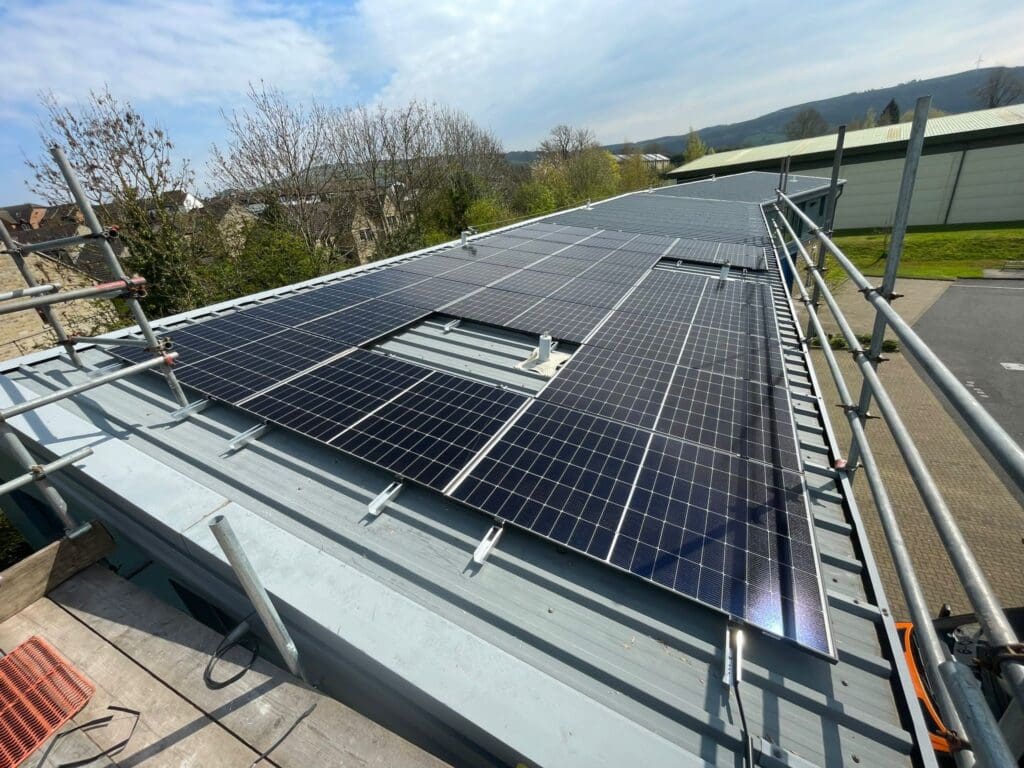
Integrating solar technology into a building’s envelope requires specialised structural engineering, electrical planning, and an intimate understanding of UK Building Regulations.

Our Services
Commercial Solar Panels
We have designed and installed high yield commercial solar panel systems for many clients. We can provide all design and payback calculations and ongoing maintenance.
Agricultural Solar Panels
We have many years experience designing and installing agricultural solar panel systems for farm businesses and saving them huge costs on electrical energy.
Residential Solar Panels
Our design and solar panel installation engineers have over a decade of experience installing and maintaining solar PV systems for residential customers across the UK
Electrical Contractors
We are NICEIC registered electrical contractors and members of the Electrical Contractors Association for all industrial, commercial and residential electrical services including testing, inspection and compliance services.
Mechanical Services
We offer M&E design, calculation, estimation and full fit-out, installation and maintenance services to commercial clients. We also provide contract maintenance and building compliance and testing services
Solar Renewables
We are MCS and RECC registered solar panel installers for all commercial and residential solar panel installations including ground arrays and roof mounted PV systems and battery storage configurations.
EV Home Chargers
We fit all makes, models and types of EV Chargers for residential customers. We are Office for Zero Emission Vehicles (OZEV) authorised installers.
EV Workplace Chargers
We can undertake all required aspects of commercial EV charging point installation, from initial design and consultation to servicing and on-going maintenance.
Gas Boiler Engineers
We are Gas Safe Registered and undertake boiler installation, servicing and all gas safety checks for landlords and residential customers.
Solar Panel Installer
Photovoltaic Systems generate no greenhouse gases, a typical domestic system can save approximately 1.2 tonnes of carbon dioxide emissions per year – adding up to almost 30 tonnes over a system’s lifetime.
Our design and solar panel installation engineers have many years experience installing solar PV systems for industrial and commercial clients.
Contact Us
Solar Panel Enquiry
Address
Keighley, West Yorkshire
BD21 4PF
UK
What3Words
What3Words:///clocks.decide.pokers
Phone
Keighley: 01535 687010 Skipton: 01756 793039